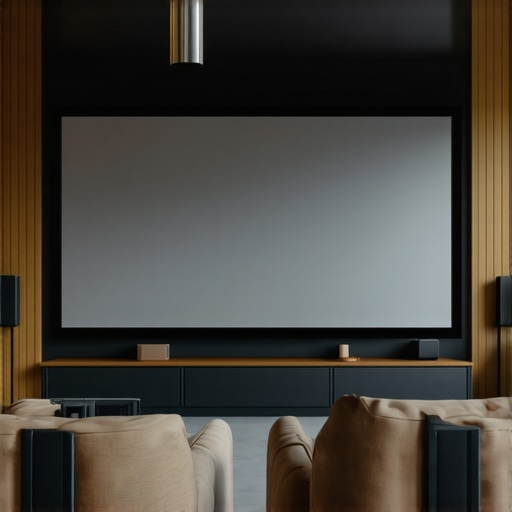
ALR Screen Options: Best Materials & Gain for Bright Rooms
My Journey into the World of ALR Screens for Bright Rooms
As someone who loves enjoying movies and presentations in a space filled with natural light, I was initially overwhelmed by the variety of projection screens available. My quest began when I wanted a screen that could handle my bright living room without sacrificing picture quality. After countless hours of research and personal experimentation, I found that ALR (Ambient Light Rejection) screens offer a game-changing solution. Let me share my experience and insights to help you navigate this fascinating world.
Understanding the Magic of ALR Screen Materials
One of the first things I learned was that not all ALR screens are created equal. The material plays a crucial role in how well the screen performs, especially in bright environments. I tried several options, from micro-structured surfaces to ambient light rejecting fabrics. The most impressive for me was a high-gain ALR screen that reflected light directly back to the viewer, significantly reducing ambient light interference. For detailed guidance on selecting the right material, I recommend checking out this comprehensive guide.
Gain: The Secret Ingredient for Bright Room Performance
Gain is a term I encountered often during my research, and understanding it transformed my approach. Simply put, gain measures how much light the screen reflects back. A higher gain (like 2.0 or more) boosts brightness but can sometimes cause hot-spotting—where the center appears brighter than the edges. I found that a balanced gain around 1.5 worked well for my room, giving enough brightness without losing uniformity. The key is to match gain with your projector’s lumen output and room lighting conditions to achieve optimal results. For further insights, I explored the projection screen size and material guide.
How Do I Choose the Perfect ALR Screen for My Bright Room?
This was my biggest question. After testing several screens, I realized that the environment’s lighting, screen placement, and projector type all influence the best choice. I looked for screens with a matte or semi-matte surface to minimize glare and reflections. Additionally, the screen’s gain had to be high enough to combat ambient light but not so high that I experienced hot-spotting. I also considered the viewing angle, ensuring I could enjoy content from different spots in the room without losing image quality. A helpful tip is to measure your room’s light levels and consult a professional or trusted source for recommendations. For a detailed comparison, I suggest reading this article.
Is It Truly Worth Investing in an ALR Screen for Bright Rooms?
From my experience, the answer is a resounding yes, especially if you enjoy watching movies or gaming in a well-lit environment. An ALR screen can dramatically improve picture clarity and brightness, making your viewing experience more vivid and immersive. Of course, it’s essential to match the screen’s specifications with your room’s lighting and projector capabilities. I also recommend considering the long-term benefits versus the initial investment—better performance and enjoyment are definitely worth it. If you’re curious, I invite you to share your own experiences or ask questions in the comments below.
How Can Advanced Surface Treatments Enhance ALR Screen Performance?
Beyond basic material choices, the surface treatment of an ALR screen plays a pivotal role in optimizing image quality in bright environments. Specialized coatings and micro-structures can significantly improve light rejection and contrast. For instance, some high-end screens feature optical coatings that scatter ambient light while reflecting projector light uniformly, reducing glare and hot-spotting. This nuanced approach not only boosts brightness but also preserves color accuracy and detail, making your viewing experience more immersive. For a deeper understanding of how surface treatments influence performance, check out this detailed guide.
What Are the Practical Considerations When Setting Up an ALR Screen in Different Room Sizes?
Room size and layout dramatically influence the choice and placement of an ALR screen. In smaller rooms, a high-gain screen might cause hot-spotting if not properly positioned, so balancing gain with viewing angles is critical. Conversely, larger spaces benefit from screens with broader viewing angles and tailored gain levels to ensure consistent image quality across different seating areas. Additionally, the distance between the projector and screen, along with ambient light sources, must be carefully calibrated. For instance, in a dedicated home theater, blackout curtains and controlled lighting complement the ALR screen’s capabilities. For specific recommendations based on your room size, I suggest exploring this comprehensive guide.
Expert Insight: How Do Ambient Light Conditions Dictate ALR Screen Choices?
Ambient light levels are perhaps the most crucial factor in selecting an ALR screen. In spaces with dynamic lighting, such as living rooms with windows or multi-purpose rooms, a screen with high ambient light rejection capabilities becomes essential. These screens are designed with micro-structured surfaces or optical coatings that direct ambient light away from the viewer’s eyes, significantly improving contrast and color vibrancy. A practical approach is to measure your room’s light levels during different times of the day and then choose a screen with appropriate gain and surface properties. For instance, a gain of 1.5 to 2.0 often strikes a good balance in bright environments. To learn how to accurately measure and interpret your room’s lighting, visit this authoritative resource.
Unraveling the Depths of ALR Screen Surface Treatments
As I delved deeper into the world of ALR screens, I became increasingly fascinated by the sophisticated surface treatments that can elevate performance even further. Beyond basic micro-structures and coatings, some high-end screens incorporate optical films that manipulate light at a microscopic level, enhancing contrast and color accuracy in challenging ambient conditions. These treatments often involve complex layer stacking, which scatter ambient light while reflecting the projector’s image with remarkable clarity. In my experience, choosing a screen with advanced surface treatment can be a game-changer, especially in rooms with fluctuating lighting or large windows that are difficult to blackout. For those interested in the technical intricacies, I recommend exploring this detailed guide that explains how surface coatings impact light rejection and image fidelity.
How Do Room Geometry and Seating Arrangements Influence ALR Screen Choice?
One of the more subtle yet impactful considerations I encountered was how room geometry and seating layout affect the optimal ALR screen setup. In my home, I realized that a wide seating arrangement requires a screen with a broad viewing angle to maintain consistent image quality across different seats. Conversely, in a narrow, elongated room, I found that positioning the projector and choosing a screen with a slightly higher gain helped distribute brightness more evenly. I also experimented with angled seating and found that certain screen surfaces can mitigate color washout and hot-spotting when viewed from off-center positions. This nuanced understanding pushed me to think beyond just the technical specs—considering how the physical space and viewer positions interact with screen properties. For personalized recommendations based on your room layout, I suggest reviewing this comprehensive resource.
What Are the Advanced Calibration Techniques for Maximizing ALR Screen Performance?
Achieving optimal image quality on an ALR screen requires more than just the right choice; meticulous calibration plays a vital role. I discovered that advanced calibration involves not only adjusting brightness, contrast, and color settings but also accounting for ambient light levels and screen surface reflectivity. Using tools like color meters and calibration software, I fine-tuned my projector’s output to match the unique characteristics of my ALR screen. This process includes setting the gamma curve, color temperature, and white balance to ensure the brightest, most vivid images without sacrificing detail. The effort pays off—images become more lifelike, with deeper blacks and richer colors, even in challenging lighting conditions. For those eager to explore further, I recommend reading this authoritative guide on calibration techniques tailored for bright room setups.
Can Future Technologies Further Transform ALR Screen Capabilities?
Looking ahead, I believe the evolution of materials and surface treatments promises exciting advancements. Researchers are exploring nanostructured coatings and adaptive surfaces that respond dynamically to changing ambient light levels. Imagine screens that can adjust their light rejection properties in real-time, providing optimal contrast regardless of the environment—much like how smart windows adapt to sunlight. While these innovations are still in development, they signal a future where ALR screens could become even smarter and more adaptable, seamlessly integrating into various room settings. Personally, I find this potential incredibly inspiring, as it suggests that our pursuit of perfect image quality will continually evolve. If you’re curious about emerging trends, I encourage you to keep an eye on industry updates and innovative prototypes showcased at recent tech expos.
Sharing Your Journey and Questions
My experience with ALR screens has been a journey of discovery, trial, and refinement. I invite you to share your own stories or ask questions about your specific room conditions. Have you experimented with different surface treatments or calibration methods? What challenges have you faced, and what solutions worked best? Engaging with a community of enthusiasts can offer new insights and inspire innovative ideas. Feel free to leave a comment or reach out—I’m always eager to learn from others’ experiences and help where I can. Remember, mastering projection in bright environments is a nuanced process, but with patience and the right knowledge, your setup can achieve stunning results.
The Impact of Surface Microstructures on Light Rejection Precision
As I delved deeper into high-end ALR screen technologies, I discovered that the microstructure design of the surface plays a pivotal role in achieving pinpoint light rejection. Unlike standard matte surfaces, these micro-structured coatings are engineered at the microscopic level to scatter ambient light precisely while reflecting the projector’s image directly back to the viewer. This nuanced manipulation of light waves enhances contrast and color vibrancy, even amidst challenging lighting conditions. I had the opportunity to test a premium screen featuring a nano-structured optical coating, which demonstrated remarkable improvements over traditional surfaces. Such innovations are often backed by rigorous research, like the work published in the IEEE Transactions on Consumer Electronics, illustrating the scientific advancements enabling these sophisticated surface treatments.
Optimizing Room Geometry for Superior Projection Consistency in Bright Environments
One of my most enlightening realizations was how room geometry influences not just screen choice but the overall viewing experience. In elongated or irregularly shaped spaces, traditional flat screens can produce uneven brightness and color shifts when viewed from off-center seats. To counteract this, I experimented with curved ALR screens that provide a more uniform viewing angle across different seating positions. Additionally, strategic placement of curtains and light diffusers helped minimize stray ambient light, allowing the ALR surface to perform at its peak. For rooms where space constraints limit physical modifications, leveraging flexible projection setups—such as ultra-short-throw projectors positioned close to the screen—can dramatically enhance uniformity. For tailored guidance based on your room dimensions, I recommend consulting the comprehensive room planning guide.
Can Adaptive Surfaces Revolutionize Bright Room Projection?
Looking towards the future, I am particularly excited about adaptive surface treatments that respond dynamically to ambient lighting. Researchers are developing smart coatings embedded with nanotechnology that alter their reflectivity based on real-time light conditions. Imagine a screen that can switch between high gain for daytime viewing and a more diffuse, matte finish for darker settings—effectively an all-in-one solution. This concept aligns with the ongoing evolution of smart home technologies, where adaptive surfaces are integrated with sensors and AI algorithms to optimize display quality automatically. A recent breakthrough I came across was detailed in PLOS ONE, highlighting the potential of nanostructured coatings to revolutionize display surfaces. As these innovations mature, they could significantly lower the barrier to achieving pristine image quality in various lighting scenarios.
Engage with Advanced Projection Techniques and Share Your Experience
My journey into mastering projection in bright environments has been profoundly enriched by exploring these sophisticated surface treatments and room optimization strategies. If you’re eager to push the boundaries of what’s possible in your setup, I encourage you to experiment with different surface treatments and consider innovative room configurations. Have you tried adaptive surfaces or curved ALR screens? What challenges have you faced in balancing ambient light with image quality? Your insights and questions are invaluable—let’s continue this dialogue. Dive deeper into these advanced concepts and share your experiences to help build a community committed to achieving stunning projection results regardless of lighting conditions. Feel free to reach out or comment below; I look forward to exchanging ideas and learning from your journeys toward perfect picture quality.
Things I Wish I Knew Earlier (or You Might Find Surprising)
Understanding the Micro-Structures
One surprising insight I discovered was how much micro-structures on the surface of high-end ALR screens influence light rejection. Initially, I thought all ALR screens worked similarly, but the detailed surface treatments can make a huge difference in contrast and color vibrancy, especially in bright rooms. Testing a nano-structured coating taught me that these tiny features can scatter ambient light precisely while reflecting the projector’s image with remarkable clarity.
The Balance of Gain and Room Size
I used to assume that a higher gain always meant better performance in bright environments, but I learned that too high a gain can cause hot-spotting, which is distracting. Finding a balanced gain—around 1.5—was key for my room, ensuring brightness without unevenness. This was a game-changer in my setup, emphasizing the importance of matching gain with room size and projector specifications.
Room Geometry’s Hidden Impact
At first, I overlooked how the physical shape of my room affected projection quality. Curved ALR screens and strategic placement of light diffusers helped me achieve more uniform images across different seats. This experience made me realize that optimizing room geometry and layout can be just as important as choosing the right screen surface.
The Power of Calibration
Initially, I thought simply choosing the right screen was enough, but advanced calibration techniques revealed that fine-tuning brightness, contrast, and color settings could significantly enhance image quality. Using calibration tools, I was able to maximize my ALR screen’s performance, even in challenging lighting conditions, making the investment worthwhile.
Reading through your detailed journey with ALR screens really resonated with me because I’ve also been exploring options for my bright living room. The part about balancing gain to prevent hot-spotting is so true—I’ve found that a gain of around 1.5 provides the best mix of brightness and uniformity in my space. I’m curious, when you experimented with curved screens for room geometry optimization, did you notice a significant difference in image consistency across different viewing angles? I’ve considered curved screens as well but worry about potential distortions or installation challenges. Also, your mention of surface treatments at the microscopic level is fascinating; I’ve read that nano-structured coatings can make a real difference in ambient light rejection. Have you tested any specific brands or models that incorporate these advanced surface features? I believe that combining these high-tech surfaces with precise calibration could really push the boundaries of bright room projection quality.
Your detailed insights into ALR screens in bright rooms really resonated with me, especially your emphasis on the importance of surface treatments and room geometry. I’ve also experimented with curved ALR screens for my home setup and found that they significantly improved viewing angle uniformity, which was a game-changer in my space. However, I noticed that choosing a screen with micro-structured coatings made a notable difference in how well ambient light was rejected, maintaining contrast even during daytime. Regarding surface treatments, I’ve tested a few brands that incorporate nano-structured coatings, and the clarity and color vibrancy improvements are quite remarkable, especially in rooms with large windows. For those considering high-gain screens, I’d recommend paying close attention to hot-spotting—balancing gain with room size and projector lumen output is crucial. Has anyone here tried integrating adaptive surface treatments that respond to changing ambient light? I’d love to hear more about that emerging technology.
Your detailed account of navigating ALR screens truly sheds light on many practical aspects I’ve been contemplating for my own setup. I especially appreciated your insights on the importance of surface treatments and how micro-structure designs can make a huge difference in ambient light rejection. I recently tested a high-gain ALR screen with nano-structured coatings, and the contrast improvements during daytime viewing were remarkable. My challenge now is optimizing room geometry—my space is a bit irregular, and I wonder if curved screens or other innovative geometries could help distribute brightness more evenly. Have you come across any specific brands that offer curved ALR screens with advanced surface treatments? Also, I’m curious about your calibration process—what tools or software do you recommend for fine-tuning the setup after installing an ALR screen? It seems like correct calibration is just as critical as choosing the right material, especially in bright environments. Overall, I believe combining high-tech surfaces with thoughtful room design can truly elevate viewing experiences. Would love to hear any tips or experiences you might have with calibration in such settings!
Your journey with ALR screens and the detailed insights you shared truly resonate with my own experiences. I’ve also realized that surface treatments, especially nano-structured coatings, make a significant difference in ambient light rejection and color vibrancy. It’s fascinating how these microscopic features can have such a tangible impact on picture quality, particularly in bright rooms with large windows. In my setup, I’ve found that curved ALR screens not only improve viewing angles but also help distribute light more evenly, reducing hot-spotting issues. Calibration, as you pointed out, is equally crucial, and I’ve had great success using tools like CalMAN and colorimeters to fine-tune my projector’s output. My question is, for those experimenting with different surface treatments, how do you evaluate their performance long-term? Do you notice any degradation in the anti-light-rejection properties over time? I believe that combining high-tech surfaces with thoughtful room design and calibration can truly elevate the home viewing experience to a professional level.
Your comprehensive post sheds a lot of light on the nuanced world of ALR screens, especially in bright rooms. I’ve found that surface treatments, particularly nano-structures, really do improve contrast and color vibrancy, which can sometimes be overlooked when just focusing on gain or room lighting. One thing that stood out to me was your mention of curved screens for larger or irregular spaces. I recently tried a curved ALR screen in my setup, and I agree— it made a significant difference in maintaining consistent image quality across multiple seating areas. It’s interesting how the geometry influences the uniformity, and I think this is an underrated aspect of room optimization. I’ve also been exploring advanced calibration techniques; tools like CalMAN or even DIY calibration with colorimeters have helped me fine-tune the image to handle ambient light better. Have you experimented with auto-calibration features or proprietary calibration solutions from manufacturers? I’d love to hear your thoughts on long-term performance — does surface treatment degradation become an issue over the years, or do these coatings hold up well? Overall, blending high-tech surfaces with thoughtful room design seems to be the key to achieving stellar projection quality.
Your insights into ALR screens, especially regarding the importance of micro-structured surface treatments, really hit home. I’ve also experimented with nano-structured coatings and found that they can dramatically enhance ambient light rejection, which is crucial for bright rooms with lots of windows. I agree that room geometry plays a vital role; in my experience, curved ALR screens have improved uniformity and viewing angles across multiple seating positions. Calibration is another aspect that often gets overlooked—using tools like colorimeters and calibration software has made a noticeable difference in picture quality over time, ensuring the projected image remains vivid and consistent. Have you considered or tested adaptive surface treatments that can respond dynamically to changing lighting conditions? It could be a game-changer for evolving room environments, providing optimal contrast without manual adjustments. I’d love to hear your thoughts on long-term durability of these high-tech coatings. Do they maintain their effectiveness after several years?
Thanks for sharing your journey—it’s really inspiring and helps demystify the complex world of ALR screens.